

Why the display rack decision matters more than the unit price
For supermarket and grocery buyers, display racks are not a one-off purchase — they define how much product a store can display, how fast staff can restock, and how easily the layout can be changed next season. A rack that looks cheaper on the unit price list often costs more over three years through broken shelves, wasted aisle space and higher installation labour.
This guide walks through the six decisions that matter when you choose supermarket display racks, followed by a checklist you can send to any supplier before requesting a quote.
Step 1: Match the rack type to your store format
Supermarket display racks are not one product. The right mix depends on your floor plan and how customers move through the store.
Single-sided wall shelving
Single-sided units stand against walls and perimeter walls. They give the deepest display area per linear metre and are usually the backbone of a grocery or convenience store layout. Use them where customers approach from one side only.
Double-sided gondola units
Double-sided gondola shelving runs down the centre of the sales floor and creates aisles. Each unit displays product on both sides, so it delivers roughly twice the display capacity per metre of floor space. The height you choose directly affects how far staff and shoppers can see across the store.
End caps and promotional zones
End caps at the ends of gondola runs are the highest-visibility positions in most supermarkets, which makes them ideal for promotions, seasonal items and impulse products. Plan end caps as part of the rack order rather than buying them separately later.
Step 2: Check load capacity and structure, not just dimensions
Two racks can have identical dimensions and completely different performance. When you compare supermarket shelving, ask for three structural details:
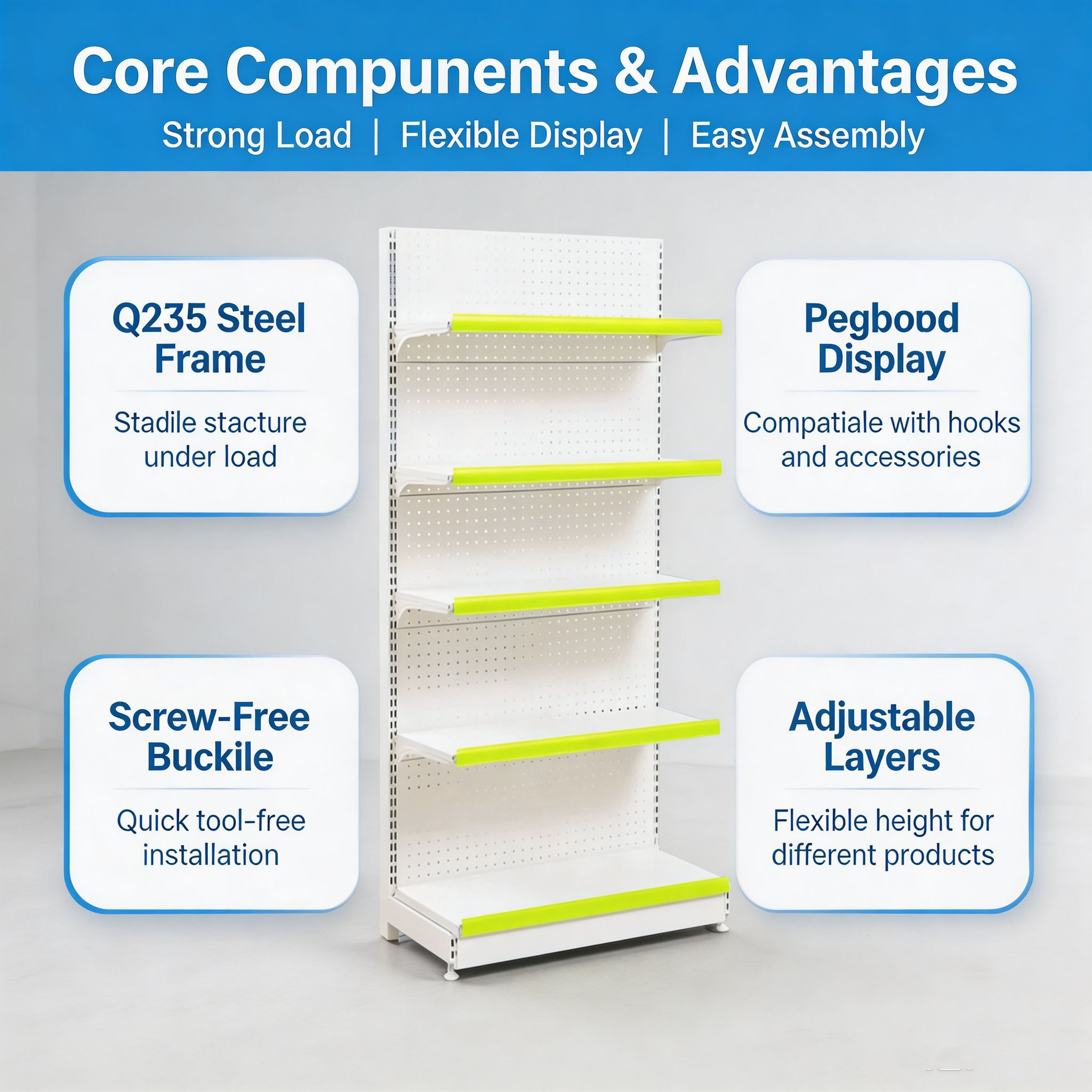
- Material and steel grade — the main frame carries the load. A frame made of Q235 carbon steel behaves very differently from thin gauge tubing used in low-cost fixtures.
- Load capacity per layer — this is the number that decides whether a layer can hold bottled drinks, bagged rice or boxed household goods. Ask for the per-layer figure rather than a single "total load" number, and ask whether heavier options are available for bulk orders.
- Surface treatment — an anti-rust finish matters in humid climates, cold-chain areas and stores with regular floor cleaning. It is the difference between shelves that still look presentable after five years and shelves that start showing rust in year two.
If your store sells heavy categories, such as beverages, bulk dry goods or pet food, decide the per-layer load requirement before you look at prices — it eliminates half of the supplier options immediately.
Step 3: Prioritise adjustable, screw-free assembly
Two features have the biggest impact on your long-term operating cost: adjustable shelf heights and tool-free assembly.
Shelf heights need to change. Product packaging changes every season, and a rack that can only hold one product height forces you to buy new fixtures instead of simply moving a shelf. Adjustable layers also let you increase the number of facings on fast-moving lines without changing the rack.
Assembly method affects both installation cost and downtime. Screw-free, boltless structures that assemble with a snap-fit design can be built, disassembled and repositioned without tools, which means your own staff or shop fitters can reset a store layout in minutes rather than planning a multi-day installation. For chains that open or refit stores regularly, this is usually the single biggest cost saving in the whole fixture budget.
Step 4: Plan for display flexibility
A supermarket display rack should be able to show more than one type of product. Look for racks where the back panel can accept display hooks, so hanging merchandise and shelf-stacked merchandise can be combined in the same unit. This matters most in categories such as accessories, seasonal goods and small impulse items, where hanging display increases visibility without taking shelf space.
Check which accessories are available at the same time — hooks, dividers, price rails, fencing and shelf liners. Accessories ordered later are usually more expensive and may not match the original batch.
Step 5: Decide what to standardise and what to customise
Most buyers get the best result with a standard module as the base and customisation only where customers will see it:
- Standardise the module depth, height and load capacity so shelves and accessories remain interchangeable across stores.
- Customise what affects brand and store image: colours, wood or steel finish, and logo printing on price rails or end panels.
For multi-store projects, confirm that custom sizes, colours and logo printing are available for bulk orders, and ask for a sample or photo of a previous custom project in your retail category.
Step 6: Work out container loading before you order
Supermarket fixtures are bulky, so freight can easily exceed the value difference between two suppliers. Two questions decide your landed cost:
- How are the racks packed? Flat-packed units that ship disassembled take significantly less container volume than pre-assembled racks, which lowers cost per unit even when the unit price is similar.
- How many units fit in one container? Ask the supplier for the loading quantity for your exact model mix — not a general figure for a single model.
Ask for packaging details and a loading plan together with the quotation.
Checklist: what to send a supplier before requesting a quote
- Store type and floor plan (supermarket, convenience, grocery, duty-free, showroom)
- Rack mix: single-sided wall units, double-sided gondola units, end caps
- Required height, depth and length per unit
- Required load capacity per layer, based on your heaviest product
- Number of adjustable layers per unit
- Whether display hooks and a pegboard back panel are needed
- Colour, finish and logo requirements for your brand
- Delivery port and target quantity per store and per order
- Whether you need layout design support
Suppliers that answer these nine points with a complete technical quotation — rather than a price list — are usually the ones set up for wholesale projects.
Five mistakes that cost supermarket buyers money
- Comparing unit prices only. Installation labour, accessories and freight usually change the ranking.
- Ignoring load capacity per layer. Under-specified racks fail at the shelf, which means replacing units in the busiest part of the store.
- Ordering accessories separately. Later orders cost more and may not match the original production batch.
- Choosing fixed shelf heights. The layout cannot adapt to next season's packaging, so you buy new fixtures instead of moving a shelf.
- Not asking for a loading plan. Without container loading figures, the landed cost per unit is unknown.
FAQ
What is the difference between gondola shelving and wall shelving?
Gondola shelving is double-sided and stands in the middle of the sales floor to create aisles, while wall shelving is single-sided and stands against a wall. Most supermarkets use both: wall units for perimeter categories and gondola runs for the main aisles.
How much load capacity do supermarket display racks need?
It depends on your heaviest product per layer. Beverages, bulk dry goods and pet food need considerably more than packaged snacks or cosmetics. Ask suppliers for the load capacity per layer and for higher-load options, then specify the requirement before comparing prices.
Are screw-free display racks strong enough for supermarket use?
Assembly method and load capacity are separate specifications. A screw-free snap-fit structure can carry supermarket-grade loads when the frame material, shelf thickness and load rating are correctly specified — so ask for the per-layer load figure rather than assuming from the assembly type.
Can supermarket display racks be customised?
Custom sizes, colours and logo printing are commonly available for bulk orders, and customised load solutions can be produced for specific product categories. Confirm the minimum order quantity and the production lead time for customised specifications.
What are typical lead times for supermarket shelving orders?
Lead time normally depends on whether the specification is a stock model or a customised one. For reference, typical stock delivery runs around 3-7 days, while customised production is usually quoted at 7-15 days, plus sea freight transit time to your port.
Choosing a supermarket display rack supplier
The right supplier for a wholesale project should be able to give you the structural specifications, the customisation options, packaging and loading data, and layout design support — not just a price. Ask for the per-layer load rating, the material grade, the assembly method and the packing details in writing, and compare suppliers on landed cost per unit rather than list price.
If you are planning a new store or a refit, send us your floor plan, rack mix and load requirements, and we will come back with a complete technical quotation and a loading plan for your port.